Break down data silos using Amazon SageMaker's lakehouse zero-ETL integrations and federated queries. Access all your data from one place while building AI applications faster.
Overview
This Guidance demonstrates how to accelerate data and AI foundation development on AWS through infrastructure-as-code and application modules. It helps organizations rapidly deploy Iceberg data lakes and Amazon SageMaker service while maintaining enterprise-grade security and governance standards. The solution shows how to implement proven architectural patterns for data management, enabling teams to focus on innovation rather than infrastructure setup. Furthermore, it demonstrates how to quickly establish data pipelines and products through a modular approach, empowering organizations to drive value from their data assets while ensuring scalability, security, and compliance.
Benefits
Accelerate AI development
Reduce operational overhead
Deploy enterprise-grade data platforms with built-in security and compliance using Infrastructure-as-Code modules. Amazon SageMaker Catalog automatically tracks data lineage and quality metrics.
Enable seamless collaboration
Empower producers and consumers to share curated data assets securely through dedicated projects. Amazon SageMaker Unified Studio provides integrated tools for analytics, ML, and generative AI development.
How it works
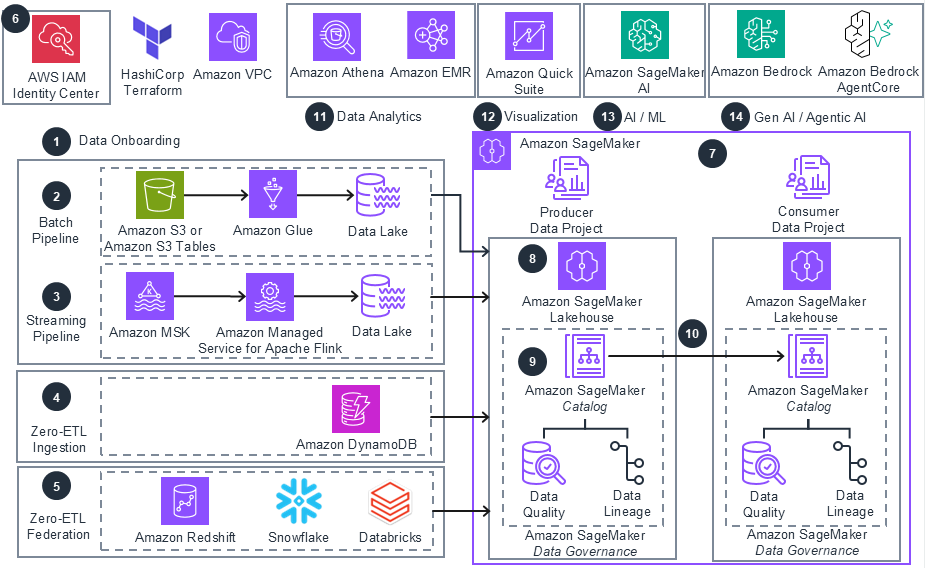
These technical details feature an architecture diagram to illustrate how to effectively use this solution. The architecture diagram shows the key components and their interactions, providing an overview of the architecture's structure and functionality step-by-step.
 Step 1
Data Onboarding: This solution provides IaC modules to provision various data onboarding mechanisms. Customers can implement batch pipelines from Amazon Simple Storage Service (Amazon S3) based data lakes, streaming pipelines, zero-ETL ingestion, and federated catalogs for external data sources.
Step 2
Batch Pipelines: Batch data pipeline can be implemented using AWS Glue to ingest structured data from an Amazon S3 bucket into hive or iceberg data lakes on Amazon S3 bucket or Amazon S3 table. Support includes: Hive data lakes on standard Amazon S3 buckets 2) Iceberg data lakes on standard Amazon S3 buckets and 3) Iceberg data lakes on Amazon S3 table buckets. Alternately, use Amazon EMR for batch data pipelines.
Step 3
Streaming Pipelines: Streaming data pipelines can be implemented using Amazon Managed Service for Apache Flink or AWS Glue Streaming to ingest messages from Amazon Managed Streaming for Apache Kafka (Amazon MSK) topics into hive or iceberg data lakes on an Amazon S3 bucket or S3 table. The Flink option is particularly useful for performing Streaming Analytics.
Step 4
Zero-ETL Ingestion: Currently, Zero-ETL ingestion IaC modules include support for Amazon DynamoDB. Zero-ETL enables direct data movement between source and target data systems without the need to build and maintain ETL pipelines.
Step 5
Zero-ETL Federation: Currently, Zero-ETL federation IaC modules include support for Amazon Redshift, Snowflake, and Databricks, enabling direct querying of data across these sources without data movement or replication, while maintaining consistent access controls and governance.
Step 6
Identity Center: This IaC module helps provision AWS IAM Identity Center instances at organization level or account level, create users and groups, and grant them required permissions. The user identities are needed login to Amazon SageMaker domain and Projects.
Step 7
Amazon SageMaker Unified Studio: The Amazon SageMaker IaC module provisions Amazon SageMaker Domains and Projects, adds members to the projects, configures Lakehouse, and adds compute, with integration into IAM Identity Center to support various Amazon SageMaker domain or project roles. The solution creates starter Producer Data Project (to curate data assets), and Consumer Data Project (to consume data assets).
Step 8
Lakehouse: Use AWS Lake Formation to federate data lakes into Amazon SageMaker Lakehouse or use zero-ETL integrations to make data available within the Lakehouse. Amazon SageMaker Lakehouse then provides a unified view across all data sources, where users can query data or build data products for downstream applications.
Step 9
Data Governance: Use Amazon SageMaker Catalog to create curated data assets and to visualize data quality and data lineage. The governance policies within Amazon SageMaker are used to ensure data access and alignment with business requirements.
Step 10
Data Collaboration: Use the producer project to produce data assets. Subscribe to data assets and consume them from the consumer project.
Step 11
Data Analytics: Use Amazon Athena to query data from the data lake, hive, or iceberg, whether stored in an Amazon S3 bucket or table. Implement deep analytics using Amazon EMR.
Step 12
Visualization: Use Amazon Quick Suite to generate AI powered dashboards and reports using data in Lakehouse. Amazon Quick Suite provides unified intelligence across all your enterprise data sources and bridges the critical "last-mile gap" between insights and action. With the built-in agents for research and automation in Amazon Quick Suite, you can explore data conversationally and take actions directly from dashboards.
Step 13
AI/ML: Use Amazon SageMaker AI to develop Machine learning and AI applications.
Step 14
GenAI and Agentic AI: Amazon SageMaker Unified Studio integrates with Amazon Bedrock, providing access to a range of high-performing foundation models (FMs) that can be used as the core intelligence for your agents. Leverage features like Amazon Bedrock Knowledge Bases, Amazon Bedrock Guardrails, Amazon Bedrock AgentCore (a comprehensive set of enterprise-grade services for securely deploying and operating AI agents at scale), and Flows within the Studio environment - to develop GenAI and Agentic AI applications - consuming data products from Amazon SageMaker.
Deploy with confidence
Everything you need to launch this Guidance in your account is right here.
Let's make it happen
Ready to deploy? Review the sample code on GitHub for detailed deployment instructions to deploy as-is or customize to fit your needs.